Global warming news

Extreme global warming seen further away than previously thought

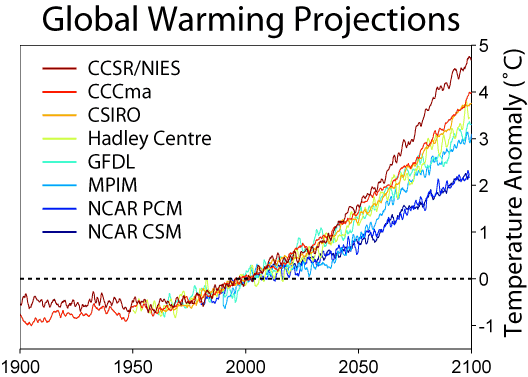
OSLO (Reuters) - Extreme global warming is less likely in coming decades after a slowdown in the pace of temperature rises so far this century, an international team of scientists said on Sunday.
Read more [Reuters]

Clouds ‘Cool Earth Less Than Once Thought’

Climate News Network: Extra cloud cover caused by emissions of industrial pollutants is known to reduce the effects of global warming, but its impact in reducing temperatures has been over-estimated in the climate models, new research has found. This is particularly significant for China and India, because it has been believed that these two giant countries would be partly shielded from the effects of climate change by their appalling industrial pollution. The Max Planck Institute for Chemistry in Germany believes...
Read more [EcoEarth.info]

Prince Charles puts heat on ministers over climate change

Telegraph: The Prince of Wales, who warned 50 months ago that there were fewer than 100 months left to save the planet from irreversible damage due to climate change, is keen to check on progress. Mandrake hears that the heir to the throne summoned Ed Davey, the Energy Secretary, and Greg Barker, the climate change minister, to a private meeting at his London residence, Clarence House, earlier this month. There have been suggestions that Prince Charles will tone down his public comments on controversial...
Read more [EcoEarth.info]

Impossible Choice Faces America's First 'Climate Refugees'

National Public Radio: Climate change is a stark reality in America's northernmost state. Nearly 90 percent of native Alaskan villages are on the coast, where dramatic erosion and floods have become a part of daily life. Perched on the Ninglick River on the west coast of the state, the tiny town of Newtok may be the state's most vulnerable village. About 350 people live there, nearly all of them Yupik Eskimos. But the Ninglick is rapidly rising due to ice melt, and the U.S. Army Corps of Engineers says the highest point...
Read more [EcoEarth.info]

Bill calls on feds to address health impacts of climate change

Hill: A bill introduced Friday calls on the federal government to craft a national strategy for dealing with the public health effects of climate change. Rep. Lois Capps (D-Calif.) is sponsoring the measure. She said climate change has factored into recent increases in allergies, asthma, tropical diseases, drought and high temperatures. “Regardless of what one believes about its causes, climate change is very real,” Capps said in a statement, adding, “We have to provide our public health officials with...
Read more [EcoEarth.info]

Experts: Increased rate of weather disasters in Ohio linked to global warming

Central Oho: Weather disasters aren’t just a big deal in the South or along the coasts, according to a new report from Environment Ohio. They also occur with some frequency in Ohio. The report, “In the Path of the Storm,” stated seven of 10 Ohioans suffered from a weather disaster in the past six years. The report compiled by the Federal Emergency Management Agency designated disasters in each of Ohio’s counties, excluding tornadoes, which haven’t been linked to global warming. Julian Boggs, state policy...
Read more [EcoEarth.info]

EU to dial back measures against global warming

Kyodo: The European Union, which has spearheaded efforts to curb global warming, is set to adopt a change of focus in response to concerns over costs and the impact on companies in economically depressed Europe. Under the change, the European Uniln will prioritize the supply of energy at affordable prices over cutting greenhouse gas emissions which impose burdens on industries, in a turnaround of the region's energy policy, an EU official said Saturday. EU leaders will decide on the shift in energy policy...
Read more [EcoEarth.info]

America’s first climate refugees: “It’s happening now … The village is sinking”

Guardian: One afternoon in the waning days of winter, the most powerful man in Newtok, Alaska, hopped on a plane and flew 1,000 miles to plead for the survival of his village. Stanley Tom, Newtok`s administrator, had a clear purpose for his trip: find the money to move the village on the shores of the Bering Sea out of the way of an approaching disaster caused by climate change. Newtok was rapidly losing ground to erosion. The land beneath the village was falling into the river. Tom needed money for bulldozers...
Read more [EcoEarth.info]

The US disconnect over climate change

Aljazeera: As scientists become more overwhelmingly convinced that climate change is man-made, why do politicians and the public give credence to global warming sceptics? A review of scientific literature published this week has found that 97 percent of peer-reviewed papers taking a position on global warming say humans are causing it. Yet, a large proportion of the US public still seems unconvinced. There is a false balance of media coverage where two or three percent of skeptics get close to 50 percent...
Read more [EcoEarth.info]

What Can Bamboo Do About CO2?

Ecology Global Network: Efforts to thoroughly study the role that plants play in climate change mitigation are increasing. Most researchers focus on the promise of large, leafy forest trees to help remove carbon from the atmosphere; for example Lal (1998) in India, Chen (1999) in Canada, Zhang (2003) in China, and Monson ( 2002) in the United States. This is because, generally speaking, the bigger the plant, the more CO2 it absorbs - and trees are the most obvious large plant species. However, there are some very large...
Read more [EcoEarth.info]

The EPA Could Lose Its Power to Fight Climate Change Before Using It

Atlantic Wire: Advocates of forceful action on climate change have long held a trump card. The primary source of greenhouse gas emissions in the U.S. is coal plants, and -since the Supreme Court has determined that those emissions are a pollutant -the EPA is mandated to regulate them. At some point, then, whether whatever president likes it or not, the agency had to make a rule limiting carbon dioxideemissions. But, what the court giveth, the court can rescind in a tightly contested vote. And with a barrage...
Read more [EcoEarth.info]

Time for civil disobedience

The tradition of civil disobedience is being reignited. The need is growing and the call to action is becoming impossible to ignore! Non-violent direct action can help re-establish a balance where our rights have been overtaken by the self interest of powerful economic elites, willing to sacrifice our children’s future for their short term gain and profit.

Peaceful acts of civil disobedience has been at the heart of many major struggles humanity has fought over the past several decades: the anti-apartheid struggle in South Africa, the Civil Rights movement in the US and Gandhi’s fight against British colonial rule in India, to mention just a few examples.

Imagine a world without civil disobedience and non-violent direct action. If that’s too abstract and difficult to imagine, try this: imagine a world where women still can’t vote, where racial segregation and institutionalised discrimination still rule, imagine brutal colonial dominance and extreme inequity and social injustice across the globe.  And while in some places we have to look to the past to find such outrageous examples of injustice and inequality, let's not  forget that there are still many places where such disturbing realities remain the norm to this day.

Actions do speak louder than words and actions are needed now more than ever given the threat that our planet is facing as a result of rampant environmental and social exploitation.

Civil disobedience and direct action are at the heart of what we do here at Greenpeace, part of our heritage and history, our destiny and mission. Civil disobedience does not require heroes – it only takes decent men and women to say ‘enough is enough’. While with Greenpeace, I have taken direct action in the freezing waters of the Arctic Ocean twice. I have climbed oilrigs representing the voice and concerns of millions of people saying that Arctic drilling is madness and must be stopped. I have even spent time in jail for this – but the fight is not over, and I will continue to support the Save the Arctic movement to stop Big Oil’s irresponsible ambitions. But this is about more than just stopping Big Oil; it’s about creating a world in which future generations can thrive, a world that is peaceful, just and equitable.

Civil disobedience seems to penetrate the consciousness of our political leaders much more than other methods. The public pressure that comes from civil disobedience can tilt public opinion and re-establish the balance between people power and the deep wallets of private companies sacrificing long-term environmental considerations for short-term profits. Political leaders can realise that they need to listen – if not because it’s the right thing to do, at least for fear of losing their mandates and positions.

A big thank you to all activists out there advancing the environmental cause, whether it’s fighting to bring justice to local communities in Nigeria suffering from Shell oil spills or stopping the Keystone XL pipeline in the US! Civil disobedience momentum is building – but much more is needed to avert catastrophic climate change and environmental destruction and degradation. Please join me and take action too!


Read more [Greenpeace international]

Fish Feeling the Heat from Global Warming

EcoWatch: A study featured in the current issue of Nature reveals that ocean warming has already affected fisheries around the world over the past four decades as fish populations shift in response to changing sea temperatures. The findings provide an indicator of the effect that climate change has on the distribution and abundance of fish. The study also points to the need for wildlife officials in New England and around the world to give fish and the ecosystems they rely upon a better chance to adapt to...
Read more [EcoEarth.info]

Fiji's villagers move uphill to escape global warming's rising seas

Telegraph: Fiji's picturesque Natewa Bay must be a hard place to leave, and for none more so than the villagers of Vunidogoloa, who are preparing to abandon their ancestral home in the face of the rising sea. But they have little choice: big waves now overtop a once-protective sea wall, their salt-polluted vegetation is dying. They are to move as a community a mile inland, and uphill, to a new site on the northern island of Vanua Levu. Devout Methodists, they have named Kenani, Fijian for Canaan – the promised...
Read more [EcoEarth.info]

Scientists agree overwhelmingly on global warming. Why doesn’t the public know that?

New York Times: Most climate scientists agree that global warming is caused by human activity, according to a new survey of published papers on climate science. "Our findings prove that there is a strong scientific agreement about the cause of climate change, despite public perceptions to the contrary,” said John Cook, the survey’s lead author, in a statement. A team of Australian and North American scholars examined 11,944 peer-reviewed climate papers written by some 29,000 climate scientists between 1991...
Read more [EcoEarth.info]

From 'Potent' Pollen to Double Whammy Allergy Seasons

ABC: Climate changes and rising carbon dioxide levels don't just affect the environment. Experts say they also affect your nose. Warmer temperatures and higher carbon dioxide levels mean certain plants will thrive, and those are the plants that tend to make us sneeze during allergy season. Allergies may seem like a minor nuisance, but according to the CDC there are an estimated 50 million Americans living with allergies, and $18 billion is spent every year dealing with the affliction. From hay fever...
Read more [EcoEarth.info]

Obama climate agenda faces Supreme Court reckoning

Reuters: With a barrage of legal briefs, a coalition of business groups and Republican-leaning states are taking their fight against Obama administration climate change regulations to the U.S. Supreme Court. The U.S. Chamber of Commerce and other industry groups, along with states such as Texas and Virginia, have filed nine petitions in recent weeks asking the justices to review four U.S. Environmental Protection Agency regulations that are designed to cut greenhouse-gas emissions. If the court were...
Read more [EcoEarth.info]

Arctic Council Takes First Steps to Reflect Global Interests

ClimateWire: The Arctic Council added China and five other countries as official observers yesterday, expanding the focus of the organization and underscoring the complicated politics created by newly open waters in the north because of climate change. The council -- which consists of eight Arctic countries -- granted observer status to India, Italy, Japan, South Korea and Singapore in addition to China. The group deferred a final decision about an observer application from the European Union, although...
Read more [EcoEarth.info]

Study: 97 percent Agreement on Manmade Global Warming

Climate Central: The scientific agreement that climate change is happening, and that it's caused by human activity, is significant and growing, according to a new study published Thursday. The research, which is the most comprehensive analysis of climate research to date, finds that 97.1 percent of the studies published between 1991 to 2011 that expressed a position on manmade climate change agreed that it was happening, and that it was due to human activity. The study looked at peer reviewed research that...
Read more [EcoEarth.info]

Study Shows Scientists Agree on Anthropogenic Climate Change

ScienceDaily: A comprehensive analysis of peer-reviewed articles on the topic of global warming and climate change has revealed an overwhelming consensus among scientists that recent warming is human-caused. The study is the most comprehensive yet and identified 4000 summaries, otherwise known as abstracts, from papers published in the past 21 years that stated a position on the cause of recent global warming -- 97 per cent of these endorsed the consensus that we are seeing human-made, or anthropogenic, global...
Read more [EcoEarth.info]

Norwegian firm to seek ways to trap cement factory CO2

OSLO (Reuters) - Norway's Aker Solutions has won a contract to make the world's first tests for capturing emissions of carbon dioxide from cement factories as part of efforts to slow climate change, the company said on Thursday.
Read more [Reuters]

Keeling's son ponders a sobering milestone

Yale Environment 360: When the history of humanity’s struggle to combat climate change is written, few characters will play as prominent a role as Charles David Keeling. A geochemist, Keeling developed an accurate method of measuring CO2 in the atmosphere, and in 1958 began recording background levels of the gas at the Mauna Loa Observatory in Hawaii. That was the start of the famous Keeling Curve, which has tracked the steady rise of atmospheric carbon dioxide. Those levels have soared from 315 parts per million when...
Read more [EcoEarth.info]

Amazing Sea Butterflies Are the Ocean’s Canary in the Coal Mine

Smithsonian: The chemistry of the ocean is changing. Most climate change discussion focuses on the warmth of the air, but around one-quarter of the carbon dioxide we release into the atmosphere dissolves into the ocean. Dissolved carbon dioxide makes seawater more acidic--a process called ocean acidification--and its effects have already been observed: the shells of sea butterflies, also known as pteropods, have begun dissolving in the Antarctic. Tiny sea butterflies are related to snails, but use their muscular...
Read more [EcoEarth.info]

Strengthening Ownership and Effectiveness of Climate Finance

The Climate Investment Funds (CIFs), one of the world’s largest dedicated funding facilities for climate change mitigation/adaptation projects,…


Read more [wri.org]

Strengthening Ownership and Effectiveness of Climate Finance

The Climate Investment Funds (CIFs), one of the world’s largest dedicated funding facilities for climate change mitigation/adaptation projects,…


Read more [wri.org news]

Untangling the Gordian knot between the oil industry and the Arctic Council

The Arctic Council — the body concerned with the future management of the region — met today in Kiruna, Sweden’s most northern city, built around the world’s largest underground iron mine. As is perhaps inevitable when digging an enormous hole in the ground, the iron mine is now found to be pulling the town down into it; Kiruna is either going to fall in, or its going to be moved, brick by brick, 4km away. The sense of a community on the edge permeates this tough Northern outpost.

Kiruna will survive, because its people are resilient and resourceful. But whether the culture, wildlife, economy and infrastructure of the region can survive the twin crises of climate change and rapid and poorly regulated industrialisation is a more open question. Not least because the Arctic Council, originally established to protect the Arctic and its Peoples, too often proves better at defending the interests of extractive industries and big business.

The governments of Norway, Sweden, Finland, Iceland, Denmark, Russia, the US and Canada all know that two-thirds of the world’s remaining fossil fuel resources must stay in the ground if we are to stand a chance of avoiding catastrophic climate change. In one report after another, Arctic Council scientists present irrefutable scientific evidence about impacts of fossil fuel extraction on the region; the loss of sea ice, the acidification of the oceans; and more locally, the huge risks of oil drilling in one of the world’s most fragile ecosystems, where it would be almost impossible to clean up a spill.

Yet the Council remains apparently paralysed and unable to take any concrete steps to stop the oil rush that is threatening to engulf this region in a cascade of changes from which it might never recover. The reason for this gulf between this understanding of risk — and the ability to act — is simple. In Canada, the US, Russia and Norway, the Arctic Council also encompasses some of the largest fossil fuel producing nations in the world — nations whose political systems, finances, wider economy and even cultures are profoundly entangled with the interests of the fossil fuel industry.

The situation is painful, absurd, tragic and deeply, deeply frustrating. Earlier today, US Secretary of State John Kerry spoke of the necessity of curbing climate change to protect future generations. He called it a life or death situation. Yet the influence of oil money on US politics remains a roadblock to all of the steps that the country could take to tackle the crisis. Canada talks of reducing black carbon emissions, whilst continuing to pour money and unprecedented backroom effort into securing global markets for tar sands — the dirtiest fossil fuel of all.

Yet grotesque as this position is, it is neither stable nor inevitable. The evidence that bold action is essential for our collective survival is overpowering. The voices of those suffering the consequences of rapid change in the Arctic — particularly the voices of Indigenous Peoples who for too long have not had control over their own futures — cannot and will not be ignored forever. Beyond the Arctic, more and more people are realising that their lives, livelihoods and cultures can only be protected if we decide to untangle the Gordian knot of our relationship with the fossil fuel industry.  From changes to the monsoon systems of Asia to the rising sea levels and devastating storms affecting people from the Seychelles to Manhattan, the consequences are clear and the choices, unavoidable.

The result is that the Arctic Council is now at a political tipping point: if they do nothing but research and chat — they will have failed the people of the Arctic and the wider global community. 

And so too is the environment is at a tipping point. The contradictions between politics and reality might make us angry, but shouldn’t allow us despair. Together we can shift the balance.


Read more [Greenpeace international]

Why Warming Oceans Could Mean Dwindling Fish

Time: It’s easy to forget that global warming doesn’t just refer to the rising temperature of the air. Climate change is having an enormous, if less well understood, impact on the oceans, which already absorb far more carbon dioxide than the atmosphere. Like so much of what goes on in the vast depths that cover more than two-thirds of our planet’s surface, the effect of climate change on the oceans remains a black box--albeit one that scientists are working to illuminate. Here’s one way: fisheries....
Read more [EcoEarth.info]

Major U.S. Cities Are at Risk for Climate-Related Water Shortage: Report

Bloomberg: Washington, D.C., New York City, Los Angeles, and San Diego are among the cities most likely to face water scarcity as climate change increases drought potential, a study released May 15 found. Along with the potentially 40 million Americans affected in these cities, several “breadbasket region” states such as Nebraska, Illinois, and Minnesota also made the list of vulnerable areas. The report, America's Water Risk: Water Stress and Climate Variability, examined how climate could affect “vulnerability...
Read more [EcoEarth.info]

Scientists say united on global warming, at odds with public view

Reuters: Ninety-seven percent of scientists say global warming is mainly man-made but a wide public belief that experts are divided is making it harder to gain support for policies to curb climate change, an international study showed on Thursday. The report found an overwhelming view among scientists that human activity, led by the use of fossil fuels, was the main cause of rising temperatures in recent decades. "There is a strong scientific agreement about the cause of climate change, despite public perceptions...
Read more [EcoEarth.info]

Analysis: Obama climate agenda faces Supreme Court reckoning

WASHINGTON (Reuters) - With a barrage of legal briefs, a coalition of business groups and Republican-leaning states are taking their fight against Obama administration climate change regulations to the U.S. Supreme Court.
Read more [Reuters]

Scientists say united on global warming, at odds with public view

OSLO (Reuters) - Ninety-seven percent of scientists say global warming is mainly man-made but a wide public belief that experts are divided is making it harder to gain support for policies to curb climate change, an international study showed on Thursday.
Read more [Reuters]

Sea levels may rise 69 centimeters until 2100 on ice melt

Bloomberg: Sea levels may rise as much as 69 centimeters (27 inches) through 2100 as water temperatures rise, glaciers melt in the Andes and Himalayas and ice sheets in Greenland and Antarctica shed water, European scientists said. The new estimate exceeds a previous forecast of as much as 59 centimeters by the United Nations’ Intergovernmental Panel on Climate Change in 2007, which didn’t fully account for the effects of melting ice, researchers with the independent Ice2sea project of 24 institutions in Europe...
Read more [EcoEarth.info]

'Best estimate' for impact of melting ice on sea level rise

BBC: Researchers have published their most advanced calculation for the likely impact of melting ice on global sea levels. The EU-funded team says the ice sheets and glaciers could add 36.8cm to the oceans by 2100. Adding in other factors, sea levels could rise by up to 69cm, higher than previous predictions. The researchers say there is a very small chance that the seas around Britain could rise by a metre. The last Intergovernmental Panel on Climate Change (IPCC) report was highly detailed...
Read more [EcoEarth.info]

Ahead of June climate change talks, UN body urges coordinated response to CO2 ‘danger zone’

UN News: In the face of "clear and present danger," the United Nations climate change body is warning that a stepped-up coordinated response is needed to fend off the impacts of climate change after the world`s carbon-dioxide concentrations surpassed their highest level in 4 million years. "The world must wake up and take note of what this means for human security, human welfare and economic development," said the Executive Secretary of the UN Framework Convention on Climate Change (UNFCCC), Christiana...
Read more [EcoEarth.info]

Nigeria: Civil Society Groups Seek Firm Response to Climate Change

Vanguard: Nigerian civil society groups under the aegis of Pan African Climate Justice Alliance, PACJA, has underlined the urgency and importance of environmental sustainability insisting that the post 2015 framework must firmly entrench responses to climate change. The group has therefore called on negotiators to break the jinx and bolster levels of ambition in the second phase of the Kyoto Protocol. Frontline environmentalist, Prof. David Okali said without rigorous enforcement, the greenhouse gas GHG...
Read more [EcoEarth.info]

Global warming trends contribute to spread of West Nile virus to new regions in Europe

ScienceDaily: Global warming trends have a significant influence on the spread of West Nile Virus to new regions in Europe and neighboring countries, where the disease wasn't present before, according to a new study by the University of Haifa. The study was commissioned by the European Centre for Disease Prevention and Control (ECDC) in Stockholm, which belongs to the European Union. The study found that rising temperatures have a more considerable contribution than humidity, to the spread of the disease, while...
Read more [EcoEarth.info]

Not only is another world possible, she’s on her way. On a quiet day, I can hear her breathing.

Opening remarks at the Peoples' Arctic Conference in Kiruna, Sweden:

Greetings my friends, and welcome to the conference, the Peoples’ Arctic: Unified for a Better Tomorrow. My name is Kumi Naidoo and I have the pleasure and honour of welcoming you here today.

First I would like to thank the Sami Peoples of Sweden for welcoming us all here and allowing us to host this meeting on their traditional territory. Ohlo-Keeto!

I would also like to thank the people of the Nordic region, who, through their support of the Swedish Postcode Lottery, have been funding this important conference for the second year in a row. And to the Swedish Postcode Lottery directly, thank you for making this all possible.

Thank you all so much for coming all this way to be here with us for this historic occasion, where Indigenous Peoples from every Arctic state have come together to share experiences, exchange stories, bond over our likenesses and learn from our differences. We at Greenpeace and the Save the Pechora Committee are honoured to be with you all here in Kiruna. 

It’s not often that we are able to gather together in this way. We live far apart from each other, in diverse lands, living unique lives — but we come together today bound by a common thread: the story of the changing Arctic — the changing landscape of your homes.

During the next two days you will hear stories from many important voices in this struggle — people like my friend Alice Ukoku, who has been fighting valiantly against the impacts of oil drilling in her native Niger Delta. Aleksei Limanzo from RAIPON will speak to you about the changing situation in Russia and Dene National and Northwest Territories Grand Chief Bill Arasmus will discuss Indigenous rights in a changing Arctic with Laila Susanne Vars, vice-president of the Sami Parliament in Norway, and Pat Pletnikoff, an Alaskan mayor. We’ll hear stories of the pitfalls and potentials of resource extraction from Mikkel Myrup, the Chair of Avataq in Greenland, as well as Francois Paulette, a Dene human rights activist from northern Canada.

I will not try to tell their stories for them. But I do want to talk to you now about other stories: the stories we tell ourselves every day; the stories we pass on to our children; the stories that some try to tell for us; and the stories that we’re changing just by being here today.

Over the last few years, in my position as the executive director of Greenpeace International, I have had the honour and the opportunity to hear stories from many of you directly about the changes you’re experiencing in your daily lives. Your homes, your ancestral lands, are changing rapidly. Everywhere on this planet, from my home in Africa to the north of Alaska, we are all experiencing the impacts of a changing climate firsthand.

And in fact, just two days ago, we hit a terrifying landmark when the concentration of carbon in the atmosphere reached 400 parts per million. Let me repeat this, for this is a tipping point for all of us: For the first time in human history, the concentration of climate-warming carbon dioxide in the atmosphere has passed the milestone level of 400 parts per million. The last time so much greenhouse gas was in the air was several million years ago, when the Arctic was ice-free, savannah spread across the Sahara desert and sea levels were up to 40 metres higher than today.

This is no longer just a theory or something we worry our children will face. We are already seeing climate change in action, all over the world. I’ve seen it where I come from, I’ve seen it in Fort Chipewyan in the Alberta Tar Sands, I’ve seen it in the Amazon where Indigenous Peoples have paid a huge price as well, and I’ve seen it in Greenland (where I had the privilege of spending almost a week’s holiday in prison in Nuuk!).

I’ve also heard from many of you that you see it every day where you live. The weather is changing. We can no longer deny this. In some places, the rains come less frequently; in others, the snowfall lasts well into spring. Deep trenches of water are appearing where before there was only ice. Reindeer and caribou, deer and moose, fox and polar bears and countless species of birds are migrating away from traditional hunting grounds, changing their patterns, beginning to adapt to a changing climate.

Across the Arctic, amid all this change, we are hearing stories of struggle and seeing signs of trouble — but also signs of emerging crusades for justice and resilience against the corporate powers that for too long have dictated our story.

Shell was forced to cancel its 2013 Arctic drilling plans after a series of failures and accidents plagued its 2012 drilling programme. Similarly, both Statoil and ConocoPhillips have both shelved plans to drill in the Arctic this year.

But beyond the oil companies, this has been a year of heroic stories for the Indigenous Peoples of the Arctic. A battle has been brewing with our allies in Russia, where RAIPON, the largest Indigenous organisation representing more than 40 Indigenous groups in Russia and the East, was ordered in November by the Russian Ministry of Justice to close its doors following what they deemed, “irregularities in its organisational statuses.” This stirred exactly the sort of international outrage that it warranted.

As expressed by Aili Kesketalo, the leading Sami politician from Norway, this challenged “the very foundation for international cooperation between Indigenous Peoples.”

In the end, after much outrage and complex politicking, this unjust decision was overturned. This marked a change in the story the Russian government was trying to tell, affirming an important lesson: that the Indigenous Peoples of the Arctic are powerful, and when united, represent an unparalleled threat to the current “business as usual” approach to Arctic management. In the words of RAIPON’s former First Vice President:

“There is an extensive hike in the level of industrialization in the north, and the Indigenous Peoples are among the last barriers against the companies’ and state’s development of the resources.”

Reading this, I was reminded of one of my favourite quotes by Ghandi,: “First they ignore you, then they laugh at you, then they fight you, then you win.”

This is also exactly what is happening in Canada where we saw other evidence of this kind of oppression in late 2012, when Indigenous Peoples were similarly vilified by the Harper government.

After being labeled by the Minister of Natural Resources as “radicals” funded by shadowy government conspirators, Harper went further, introducing bills containing huge, draconian amendments to environmental assessment and protection — and buried in there were changes to many laws that removed tens of thousands of rivers and lakes from federal protection, including bodies of water to which aboriginal groups have registered legitimate claims and declarations of interest.

This spurred an unparalleled uprising, a massive movement called Idle No More, which brought together tens of thousands of people from across Canada, from Indigenous and non-Indigenous communities, standing together in opposition to this clear undermining of human rights of Indigenous Peoples in Canada, and in clear contrast to their treaty rights.

The story of the Idle No More movement is hugely inspirational but also extremely nuanced — but over the course of the next two days, I encourage you to seek out your Canadian Indigenous allies and ask them about this uprising, about what it means for them, and what it says about the Canadian government that is just this week assuming chairmanship of the Arctic Council.

Amid all of this oppression shines an underlying story: a light of resistance, power, and hope. Indigenous Peoples everywhere are fighting back. You are being recognised as the stewards of the land and the powerful force that you are; you are demanding that your treaty rights be honoured, and finally I hope that you are being heard by the governments that first ignored you, then laughed at you, then fought you, and then conceded.

You’re not alone. All over the world, people are joining forces, moved by the stories of what’s happening in the Arctic, and inspired to act to change the power structure, take it away from the big corporations and put it back in the hands of the people.

I see this week as an opportunity for Arctic Indigenous Peoples to have your voices heard. In these big political games, where the story has long been about whoever has the most money and power gets to call the shots, where the people with money get to carve up your land and divide the resources, it is imperative that your story be told, and that the right people be made to listen.

While you lose your right to sustain yourself in a traditional way off the land, they make money. While you are getting hungrier for untainted food and water, they get hungrier for more power and control. This is not a just story. It is not one I want anything to do with. It is not right, it is not equitable, and it is certainly not sustainable. And so we must change it.

We must change the questions that are being asked and the answers that are being given in false justification. These corporations are asking themselves, how much can we consume? How quickly can we extract all this oil? When really the questions they should be asking are, to whom does this land belong? And who should have the right to decide how it’s managed? Who will suffer tomorrow’s consequences of our decisions today?

The authorities will often frame the story as this: oil equals sustainable development and a better quality of life for Indigenous Peoples living here, versus no oil equals no prospects for local communities in the North. This is a false dilemma and tantamount to blackmail. We have learned time and again that access to oil does not mean positive growth for Indigenous and local communities. In fact, coming from Africa, I know that being rich below the ground almost always equals poverty above ground. But your stories do not have to end this way.

In a few decades, oil will be gone. Experts say that we passed peak oil production in 2010. So why should we risk the last pristine ecosystems on the planet in the race for the last drops of oil? And who will take the responsibility for cleaning up the mess these companies will leave behind when they are done sucking everything out of the Arctic? Not the companies, no, we have learned this. And not the Arctic Council either — their new toothless oil spill response plan has proven this. Time and again, we have learned the sad truth that neither governments nor industry can be trusted to do this.

This week Greenpeace and the Save the Pechora Committee are here to learn from your experiences, to listen to what you want, and to help amplify your voice in this struggle. To help tell the stories you want to tell.

It is no secret that historically, Greenpeace hasn’t always done right by Indigenous communities. We made some errors many years ago, but we are learning from past mistakes. So let me be clear on this point — Greenpeace unequivocally supports subsistence whaling and hunting. 

However at this critical point in history, it’s important to recognise that there is far more that unites us than divides us, and it’s that unity of purpose that we want to explore.

Last year when I addressed a similar conference we held in Russia, I told some of you that we would not solve all the problems we face with one conference, nor will we solve them with two. But together we made great strides. The attendees of the conference sat together crafting a joint statement of opposition to Arctic drilling. For hours they talked around the table, exchanging ideas, honing the language, fine-tuning the set of demands until there was unanimous agreement. The result of that meeting was a strong statement that other Arctic Indigenous Peoples have continued to sign on to since then. The statement is here, and you’ll be given the opportunity to read through it and sign if you so choose.

These meetings and these collectively crafted agreements are critical steps in forging new and lifelong relationships that I believe will be pivotal in forming our collective future. Together we are consciously creating the sort of stories and the kind of world that we will all live in together, and that we will leave behind for future generations to inherit.

This is no small task. In fact, it is a huge responsibility, and one that I do not take lightly. Just by being here and demonstrating your commitment and willingness to work with your contemporaries around the world, shows me that you all share this burden.

There is an old Cree Proverb that I’m sure many of you know, that says, “Only after the last tree has been cut down, Only after the last river has been poisoned, only after the last fish has been caught — Only then will you find that money cannot be eaten.” 

And you know, this is happening. I truly believe that there is a shift in consciousness happening right now. We stand here today on the precipice of a new world.

It is daunting, and sometimes scary — but it is also a unique and inspiring opportunity. All across this planet I am humbled by what I am witnessing firsthand — a deep commitment, passion and vision of people who see another way forward. Who envision another kind of world for their children — one that respects the earth and honours her fragility; Peoples from north to south, east to west, who have grown tired of an economic paradigm that values profit over people, and greed over green. People who are standing up and standing together, claiming their rights as human beings, and demanding they be heard.

Every day I draw my inspiration and my strength from these people — from people like each of you who stand in this room. I am humbled by your individual vulnerability and your collective strength.

And you are not alone.

Last month, a group of young ambassadors — including Kiera Dawn-Kolson and Josefina Skerk, two Arctic Indigenous representatives and both of whom are here today — embarked on a quest with Greenpeace to the North Pole, to plant the names of three million people on the seabed below the North Pole — three million people from nearly 60 countries on earth, all united in their determination to secure Arctic protection. They all know what we do: that our fates are intertwined with the fate of the Arctic. They left their homes in the Seychelles, in the Northwest Territories of Canada, in the north of Sweden and in New York, to create a new conversation about the future of the Arctic. To tell different stories and to change the narrative from the current paradigm to the new reality we all envision.

On the seabed at the North Pole they planted an indestructible glass time capsule. There it sits now holding the names of 2.7 million people, including some of yours, a testament to our joint commitment. Inscribed around the capsule on a titanium ring is a quote from one of one of the most powerful storytellers from India. Her name is Arundhati Roy. The quote is from one of her novels, The God of Small Things, and it says: “Not only is another world possible, she’s on her way. On a quiet day, I can hear her breathing.”

My friends, I believe that right now we are bearing witness to this. I believe the new world we seek is on its way.

Together with you all, we stand here today to affirm our commitment to creating this new world together, to asserting our right to ensure our future, to ensure our very lives, which may sometimes seem far apart, but are in reality wholly connected. With your blessing, I promise we will work to make the governments of the Arctic realise that your voices cannot and will not be ignored. Together we will continue in our battle to protect the Arctic and your rights as the true inhabitants of this unique place.

Over the next two days, I hope we will forge new relationships and strengthen old ones. I encourage you to use the breaks to make friends and speak to each other. I encourage you to ask Kiera and Josefina about the mission they have just returned from, and to share stories with them in return. More than anything at this conference, I look forward to hearing — and learning from — your stories.

These stories we tell each other will form the narrative that we create, block by block, and character by character; do not underestimate their power. These stories will shape our futures, and the future of this planet that we call home.

And history is also our teacher here in terms of our ambitions to address the destruction that is happening in the Arctic. Twenty years ago when Greenpeace and other groups pushed for the Antarctic to be declared a global commons protected from industrial exploitation, everyone said, you’re crazy, you don’t stand a chance, you’ll never win.

But they were wrong. And now more than two decades later, Antarctica is still protected, and this achievement has helped in some way to mitigate runaway climate change.

The irony is that Antarctica, which isn’t even home to human beings, is now protected. So how is it that the Arctic, home to millions of people, including some of the most precious and unique communities in the world, cannot secure the same protection where people need it most?

The answer is that we can, and we must. This reminds me of a quote from the Maori, the Indigenous Peoples of New Zealand/Aotearoa — about exactly this point, which I’d like to end on, because I think it perfectly encapsulates why we are all here:

He aha te mea nui o te ao? 
He tangata! He tangata! He tangata!

What is the most important thing in the world? 
It is people! It is people! It is people!


Listen to Kumi Naidoo's speech here.


Read more [Greenpeace international]

Climate change to halve habitat for over 10,000 common species

Mongabay: Even as concentrations of carbon dioxide in the atmosphere hit 400 parts per million (ppm) for the first time in human history last week, a new study in Nature Climate Change warns that thousands of the world's common species will suffer grave habitat loss under climate change. "While there has been much research on the effect of climate change on rare and endangered species, little has been known about how an increase in global temperature will affect more common species," says lead author Rachel...
Read more [EcoEarth.info]

Tanzania: Bamboo farming can offset carbon emission

Daily news: THE idea to cultivate bamboo may sound strange and ridiculous in this country but the fact that deforestation is taking place at an alarming rate with unparalleled tree planting efforts; time has come for Tanzania to learn from other countries about alternative measures to mitigate effects of climate change. Environmentalists throughout the world have proposed bamboo farming as an alternative way to offset carbon emission from the human population. Contrary to popular belief, bamboo is very durable...
Read more [EcoEarth.info]

A Change in Temperature

New York Times: Since 1896, scientists have been trying to answer a deceptively simple question: What will happen to the temperature of the earth if the amount of carbon dioxide in the atmosphere doubles? Some recent scientific papers have made a splash by claiming that the answer might not be as bad as previously feared. This work -- if it holds up -- offers the tantalizing possibility that climate change might be slow and limited enough that human society could adapt to it without major trauma. Several scientists...
Read more [EcoEarth.info]

Global Temperature Increases Could Threaten Global Biodiversity

RedOrbit: If global temperatures increase by more than two degrees Celsius, it could have a dramatic impact on the biodiversity of both plants and animals, according to new research published in the latest edition of the journal Nature Climate Change. In fact, according to BBC News Environment Correspondent Matt McGrath, the authors assert that more than half of common plant species and one-third of all animals could experience a serious decline in their habitat range because of global warming. However, they...
Read more [EcoEarth.info]

Cool time-lapse imagery of the earth's climate changing over 30 years

AMERICAblog: Using satellite photos from Landsat, a joint mission between the USGS and NASA, Google has partnered with Carnegie Mellon University to put together a very cool series of time-lapse images of the earth, showing changes in the earth, including impacts of climate change. Some of the specific time-lapse images, below, show the Columbia Glacier retreating, urban growth in Las Vegas, the expansion of the Dubai coastline, the deforestation of the Brazilian Amazon. It`s pretty cool stuff. Here are...
Read more [EcoEarth.info]

Cities need the resilience to face future Sandys

Bloomberg: Whether or not Hurricane Sandy had a connection to climate change, climate change will make future Hurricane Sandys more common, imposing enormous costs on cities. Since we seem to lack the will to reduce this threat by cutting greenhouse-gas emissions, we should at least make ourselves more resilient to severe weather. So it's encouraging to see cities and states worldwide work on better protecting themselves from storms. Rotterdam, for one, has set a goal of being "climate-proof" by 2025....
Read more [EcoEarth.info]

One-third of animal species will be hit by climate change, scientists warn

Guardian: One-third of common land animals could see dramatic losses this century because of climate change, scientists predict. More than half of plants could be hit the same way as habitats become unsuitable for numerous species. The collapse of ecosystems would have major economic impacts on agriculture, air quality, clean water access, and tourism. Global temperatures are set to rise 4C above preindustrial levels by 2100 if nothing is done to stem greenhouse gas emissions. This could have a...
Read more [EcoEarth.info]

USA holds key to aviation emissions deal

RTCC: United Nations negotiations to contain emissions from planes and ships recommence in Montreal and London this week, with hopes for a global climate change deal in 2015 resting on these two sectors. Only China, USA, India and Russia emit more atmosphere-warming greenhouse gases than the global contribution of shipping and aviation, which tops 1.6 bn tonnes of CO2 a year. These talks are difficult given the limited alternatives to each mode of transport and increasing demand around the planet....
Read more [EcoEarth.info]

Australia: Why Labor should fight the 2013 election on climate change

Business Spectator: If climate change features prominently in the federal election campaign, it will almost certainly be driven by the Coalition. Under Tony Abbott, the Coalition has long smelled blood in the water on climate change and in particular the carbon tax. Abbott has stated repeatedly that the repeal of the carbon tax will be his first order of government business if elected, while Coalition climate spokesperson Greg Hunt has claimed that the 2013 election will be a referendum on the tax. But this is...
Read more [EcoEarth.info]

The effect of climate change on iceberg production by Greenland glaciers

SPX: While the impact of climate change on the surface of the Greenland ice sheet has been widely studied, a clear understanding of the key process of iceberg production has eluded researchers for many years. Published in Nature this week, a new study presents a sophisticated computer model that provides a fresh insight into the impact of climate change on the production of icebergs by Greenland glaciers, and reveals that the shape of the ground beneath the ice has a strong effect on its movement....
Read more [EcoEarth.info]

European energy chief puts forward case for funding coal

Guardian: One of Europe's most influential government-owned investors in the energy industry has hinted it may expand funding of high-carbon coal projects despite mounting pressure from climate change campaigners to rule out such investments. Riccardo Puliti, energy chief at the European Bank for Reconstruction and Development (EBRD), warned against an "ideological" policy on carbon intensity in funding decisions without giving weight to other considerations. The EBRD, which is based in London and owned...
Read more [EcoEarth.info]

Climate Change Will Cause Widespread Global-Scale Loss of Common Plants and Animals, Researchers Predict

ScienceDaily: More than half of common plants and one third of the animals could see a dramatic decline this century due to climate change, according to research from the University of East Anglia. This means that geographic ranges of common plants and animals will shrink globally and biodiversity will decline almost everywhere. Plants, reptiles and particularly amphibians are expected to be at highest risk. Sub-Saharan Africa, Central America, Amazonia and Australia would lose the most species of plants...
Read more [EcoEarth.info]

Canada: Cracks in the house? Climate change dries the ground we stand on

Ottawa Citizen: We learn from Saturday’s paper that carbon dioxide, the main greenhouse gas, is at its highest concentration in the atmosphere in three million years. Over shouts of “We’re No. 1!”, it might be opportune to mention an unexplored consequence of climate change: our houses are cracking up. Ottawa is built, with some exceptions, on a vast stretch of what the experts call “sensitive clay soil”, usually referred locally as leda, the old basin of the Champlain Sea. During a prolonged drought in...
Read more [EcoEarth.info]

The following articles are automatically syndicated feeds about global warming (climate change) from other sites.


XML feed